
Post-Holiday Bloating: How to “Wake Up” Your Second Brain with Massage
When the holidays end, it is almost inevitable to hear someone comment on how heavy and uncomfortable their stomach feels, although curiously, we dive headfirst into strict diets hoping for relief. The true root of the matter often goes unnoticed: there is a hidden conductor, your “second brain,” making crucial decisions behind the scenes. I’m referring to the Enteric Nervous System, a meticulous network of neurons capable of adapting digestion to daily vicissitudes. But just a change in the pace of life or increased tension is enough for this system to become completely disoriented and lose control over the digestive process, sometimes needing something more than just good will… like an expert hand to guide it back on track.
Why Do You Feel Bloated? The Connection Between Stress and Your Digestion
After a holiday binge, it is not just the quantity of food, but above all the stress that seems to transform the belly into an uncomfortable balloon. Juggling social commitments or ending up exhausted leaves your “second brain,” the Enteric Nervous System (ENS), with no room to maneuver, and it responds in the only way it knows how: by blocking different stages of digestion. It sometimes behaves like a demanding conductor who pauses the rest of the orchestra if they sense too much external pressure.
When famous hormones like cortisol and adrenaline kick into action due to the stress of these days, the body deploys its particular emergency plan, prioritizing muscular and neural attention. Naturally, digestion becomes the least of its concerns during that time, and your abdomen notices it immediately. In short, your second brain takes a back seat.
- Reduces intestinal motility: The typical movement of the intestine, essential for not feeling bloated, slows down so much that gases and the sensation of heaviness also appear immediately.
- Decreases digestive secretions: As the production of juices to break down food drops, suddenly even the simplest leftovers seem indigestible.
- Alters the microbiota: Just when you think stress couldn’t be more annoying, it also affects the good bacteria in your gut, which were already somewhat strained by dietary changes.
Thus, the combination of binge eating and that typical holiday nervousness wreaks authentic havoc on the ENS, halting the digestive process and sowing the perfect ground for bloating. It’s a sort of perfect storm after days of celebration, don’t you think?
Manual Therapy: How an Abdominal Massage “Wakes Up” Your Second Brain
It might sound exaggerated, but there are simple gestures that seem to have superpowers. An abdominal massage, for example, works almost as if you gave your intestines a “double espresso” to perk them up. It is not a matter of magic, but a technique that manages to reactivate the digestive rhythm when your system proves especially lazy after stress, helping everything to roll again.
The Science Behind the Massage
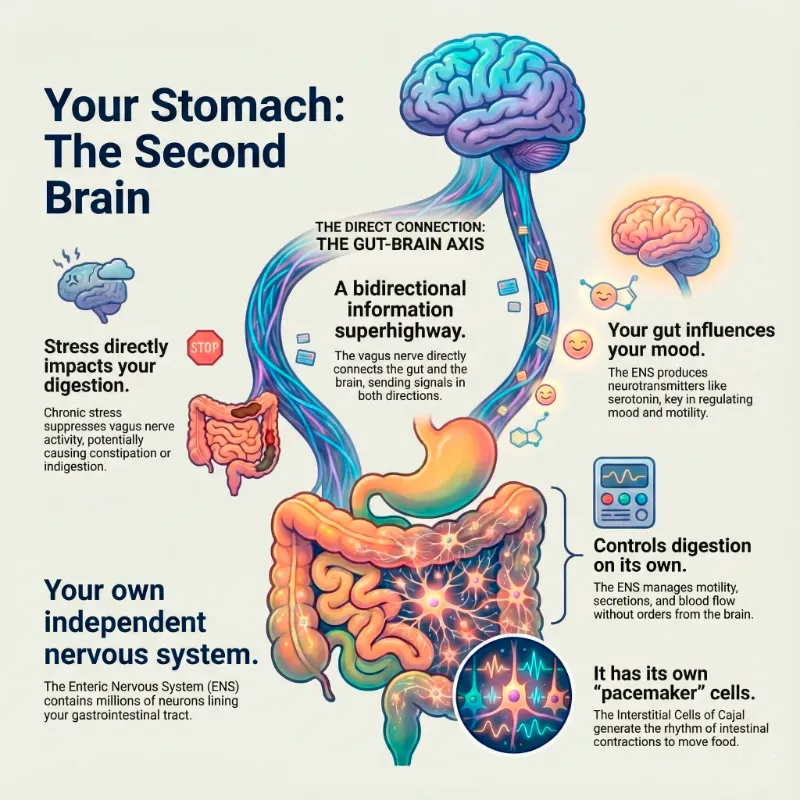
Why does this work? It turns out that by applying gentle, rhythmic pressure to the abdomen, sensors are activated that, like little switches, send urgent messages throughout the digestive neuronal network. Thus, circuits lulled to sleep by stress receive a clear “let’s get to work” signal.
- Auerbach’s Myenteric Plexus: This is something like the boss that sets the intestinal pace. When it receives the massage signal, it orders the release of messengers like acetylcholine, facilitating contractions and mobilizing the waste that is so uncomfortable after the holidays.
- Meissner’s Submucosal Plexus: Another key control that adjusts the production of juices and circulation in the area. The massage, almost directly, optimizes the absorption and processing of what you eat, helping nutrients to be utilized faster again.
By the way, we cannot forget the famous Interstitial Cells of Cajal (ICC), whose name sounds complicated but whose job is to “set the pace” of the intestine. External pressure simulates that everything is starting up again, helping to pick up the lost natural rhythm.
How Does This Translate into Relief?
This coordinated effort revitalizes your ENS, making it feel more capable of handling difficult meals and neutralizing the discomfort of accumulated stress. Something almost magical happens with the stimulation of the vagus nerve, which sends a direct message of calm between the belly and the mind and contributes to reducing cortisol levels so that stopping feeling bloated becomes, frankly, a more accessible reality.
What Real Results Can You Expect from Abdominal Massage?
If someone tells you that abdominal massage is just a placebo, they are mistaken. Experience with patients with digestive problems makes it clear: it helps recover transit and lower intense pain, although science still has pending an analysis of the immediate effect right after the holiday season.
Among the studied techniques are usually the classic massage along the colon, the “I Love U” (ILU) maneuver, and manual lymphatic drainage. These sessions, which rarely exceed 20 minutes, have proven in clinical practice to be as safe as they are effective. Do not underestimate them if you are looking for quick and safe relief.
Demonstrated Clinical Benefits
The sum of relevant studies offers interesting backing to manual therapy, showing quite notable improvements in different areas:
| Observed Benefit | Description of Result |
| Increased frequency | Statistically significant increase in the number of weekly bowel movements. |
| Reduced transit | Decrease in colonic transit time by more than 20 hours on average. |
| Improved consistency | Normalization of fecal consistency, measured according to the Bristol Stool Scale. |
| Pain relief | Reduction of visceral hypersensitivity and abdominal pain, especially in IBS. |
| Decreased bloating | Improvement of lymphatic drainage, helping to eliminate liquids and reduce congestion. |
What Does This Mean for Post-Holiday Bloating?
In short, the results suggest that by increasing the speed of intestinal transit and favoring liquid cleansing, massage provides a real respite from bloating. If it also reduces pain and tension, the relief is not only physical but also mental, which is especially essential after intense holidays.